Quick answer: this plan splits SEO work into seven weeks: keywords, structure and indexing, on-page optimisation, content, technical performance, authority and measurement. Each week has one deliverable and one KPI. The seven weeks build the foundations; for competitive searches, results usually take several months to consolidate.
Reaching the first page of Google doesn’t happen by chance. It requires structure, consistency, and a clear action plan.
This 7-week SEO roadmap was designed to help businesses and marketing professionals build strong foundations, increase online visibility, and generate sustainable organic traffic — step by step.
We begin with Week One, the cornerstone of every successful SEO strategy.
The 7-Week SEO Plan at a Glance
| Week | Focus | Main deliverable | How to measure |
|---|
| 1 | Keyword research | Prioritised keyword list | Baseline rankings recorded |
| 2 | Structure and indexing | Site map and submitted XML sitemap | Indexed pages in Search Console |
| 3 | On-page optimisation | Revised titles, descriptions and headings | Organic CTR |
| 4 | Content | New or updated pages for priority keywords | Impressions and average position |
| 5 | Technical performance | Core Web Vitals within thresholds | LCP, INP and CLS |
| 6 | Authority | Link plan and Google Business Profile | Referring domains |
| 7 | Measurement | Report and next-cycle priorities | Organic clicks, conversions and revenue |
How long does it take to see results?
The seven weeks put the foundations in place; they do not guarantee a first-page ranking. In the 2017 video How to hire an SEO, Maile Ohye, then at Google, explained that in most cases it takes four months to a year to implement improvements and start seeing potential benefits. Long-tail, low-competition keywords tend to move sooner.
Week One: Uncovering Profitable Keywords for SEO Success
During the first week, your main focus should be identifying keywords with real business potential.
These are keywords that:
-
attract qualified traffic
-
reflect strong user intent
-
have conversion potential
-
position your brand competitively
SEO is not just about search volume — it’s about intent, relevance, and opportunity.
Building a List of Relevant Keyword Ideas
Start by brainstorming and compiling a broad list of keywords related to your business, products, or services.
At this stage, the goal is exploration, not filtering.
Think about:
-
what your customers search for
-
problems they want to solve
-
questions asked before purchasing
-
terms used by competitors
This list will serve as the foundation of your entire SEO strategy.
Identifying the Real Opportunities
Once your keyword list is ready, it’s time to identify the true opportunities.
Prioritise keywords that combine:
This allows you to focus your efforts where SEO can deliver the greatest return.
Setting Up Automated Keyword Tracking
To measure progress effectively, you must implement automated keyword tracking.
Tools such as Ubersuggest, SEMrush, or Ahrefs allow you to:
SEO should never rely on guesswork — it should be data-driven.
Why Week One Matters
Week One isn’t just about choosing keywords.
It helps you understand:
-
how your audience searches
-
how Google interprets intent
-
how SEO supports long-term business growth
By mastering this first step, you create a solid foundation for everything that follows.
Next step:
In Week Two, we’ll focus on website structure and content architecture to improve crawlability and indexation.
Week Two: Site Structure and Indexing
With your keywords defined, organise the site so that Google and your users can find every page easily.
-
Group keywords by topic and give each group one main page, so that two pages do not compete for the same search.
-
Use short, descriptive URLs and a shallow page hierarchy.
-
Add internal links between pages on the same topic.
-
Generate an XML sitemap, submit it in Google Search Console and check your robots.txt file.
-
Use the Search Console indexing report to confirm that your key pages are indexed.
Week Three: On-Page Optimisation
-
Write a unique title for each page, short enough not to be cut off in search results (in practice, up to around 60 characters), with the main keyword near the start.
-
Write a meta description that summarises the page and invites the click.
-
Use a single H1 and H2 and H3 subheadings that follow the questions users ask.
-
Add descriptive alt text to images and keep files light.
-
Add structured data (schema.org) that matches the page type: article, product, organisation or local business.
Week Four: Content That Matches Search Intent
-
Create or update content for your priority keywords, starting with those closest to a purchase decision.
-
Answer the main question in the first 40 to 60 words: it helps both Google and AI answer engines.
-
Use questions as subheadings, comparison tables and sourced data.
-
Show real experience: case studies, examples and a named author (the E-E-A-T criteria in Google’s search quality rater guidelines).
-
Update or merge older articles that compete with each other.
Week Five: Technical Performance and Page Experience
Google’s ranking systems use Core Web Vitals as page experience signals. The thresholds considered good, measured at the 75th percentile of visits, are:
| Metric | What it measures | Good value |
|---|
| LCP (Largest Contentful Paint) | Loading speed of the main element | 2.5 s or less |
| INP (Interaction to Next Paint) | Responsiveness to interactions (replaced FID in 2024) | 200 ms or less |
| CLS (Cumulative Layout Shift) | Visual stability of the page | 0.1 or less |
Source: web.dev (Google).
-
Compress images and use modern formats such as WebP or AVIF.
-
Reduce render-blocking JavaScript and CSS.
-
Check that the site works well on mobile and runs on HTTPS.
Week Six: Authority and Off-Site Presence
-
Find sites that already cover your sector and offer useful content (studies, guides, original data) that is worth citing.
-
Reclaim unlinked brand mentions and broken links pointing to your site.
-
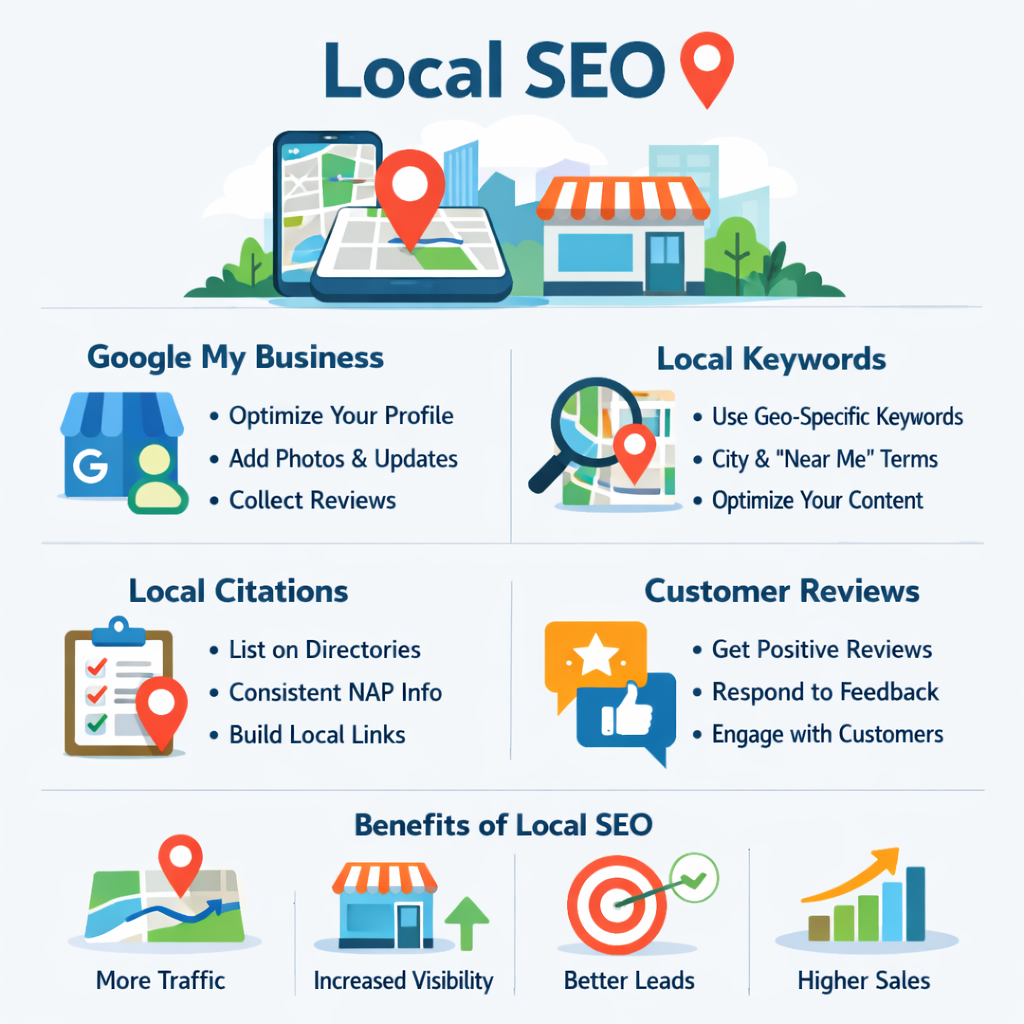
Create or update your Google Business Profile if you serve a specific area.
-
Keep your company name, address and phone number consistent across directories.
-
Do not buy links: it breaches Google’s spam policies.
Week Seven: Measure, Report and Plan the Next Cycle
-
Compare positions, clicks and impressions in Search Console with your Week One baseline.
-
In Google Analytics 4, measure organic traffic, conversions and revenue by landing page.
-
List what worked and what did not, and set the priorities for the next seven-week cycle.
-
Prepare a short report with three to five KPIs for management.
Frequently Asked Questions About the SEO Plan
Can you reach Google’s first page in 7 weeks?
For niche, low-competition searches, yes. For competitive terms, rarely: the seven weeks build the technical, content and authority foundations, and results consolidate over the following months. That is why the plan should be repeated in cycles, guided by what the data shows.
Which tools do you need?
Google Search Console and Google Analytics 4 are free and cover indexing, average position, clicks and conversions. For keyword research and rank tracking, tools such as Semrush, Ahrefs or Ubersuggest save time. PageSpeed Insights, also free, measures Core Web Vitals.
Do you need to follow the weeks in order?
The first three, yes, because each depends on the one before: without keywords there is no structure, and without structure on-page optimisation loses its impact. Weeks five and six can run alongside week four if you have the team for it. Week seven closes the cycle and sets up the next one.